Superposition principle
Claimed by Rithwik Sharma Fall 2025
This page explains the superposition principle and brings together examples, models, and applications to make the idea easier to learn.
The Main Idea
The superposition principle says that when several influences act on a system, the total response is the sum of the individual responses. For electric fields, this means each charge creates its own field independently, and the net field is found by adding all of them as vectors.
It shows up in many areas of physics and engineering. In circuits, the total voltage at a node can be found by adding contributions from multiple sources. In mechanics, forces from different components of a structure add to give a net reaction. In fields, superposition makes it possible to calculate complex electric and magnetic environments by breaking the problem into simpler pieces.
All in all, the key idea is that each contribution acts independently. Nothing “distorts” another field, so the total is just the vector addition of all of them.
A Mathematical Model
The net electric field due to two or more charges is the vector sum of each field due to each individual charge. This not only applies to Electric Fields, but Magnetic Fields as well. It is important to note that in the superposition principle, the electric field caused by a charge is not affected by the presence of other charges. It is important to note that this principle applies to all linear systems, note just those of fields. It has the same net result for mechanics as well. Below are the 2 predominate mathematical models for the principle.
- [math]\displaystyle{ F(x_1+x_2)=F(x_1)+F(x_2) \, }[/math]
- [math]\displaystyle{ F(a x)=a F(x) \, }[/math]
A Computational Model
Here is a python program that calculates and displays the electric as well as magnetic field at a specific observation location for a moving dipole. The dipole is a negative and positive charge q and distance s. Write a porgram that will use the given constants to do this.
   # GlowScript 2.0 VPython

   magconstant = 1e-7
   oofpez = 9e9
   q=1.6e-19
   s = 1e-9
   pluscharge = sphere(pos=vector(-5*s, 0,-s/2), radius=1e-10, color=color.red)
   minuscharge = sphere(pos=vector(-5*s, 0, s/2), radius=1e-10, color=color.blue)
   velocity = vector(4e4,0,0) # The dipoles cm velocity
   robs = vector(0,s,0)

   # Initializes two arrows (E and B) at the observation location
   E = arrow(pos = robs, axis=vector(0,0,0), color = color.cyan)
   B = arrow(pos = robs, axis=vector(0,0,0), color = color.magenta)

   # Loop that updates dipole position as well as electric and magnetic field
   dt = 1e-18

   while pluscharge.pos.x < 10*s:

       rate(100)

       rplus = robs - pluscharge.pos
       rplusmag = mag(rplus)
       rplushat = norm(rplus)

       Eplus = ((oofpez * q) / (rplusmag ** 2))
       Bplus = magconstant * q * cross(velocity, rplushat) / rplusmag ** 2

       rminus = robs - minuscharge.pos
       rminusmag = mag(rminus)
       rminushat = norm(rminus)

       Eminus = (oofpez * (-q) / (rminus ** 2)) * rminus
       Bminus = (magconstant * (-q) * cross(velocity, rminushat)) / (rminushat ** 2)

       #Calculates the new E and B net fields
       Enet = Eplus + Eminus
       Bnet = Bplus + Bminus

       # Updates the E and B fields arrows
       E.axis = Enet
       B.axis = Bnet
       from visual import * #import the visual module

       rod = cylinder(pos=(0,2,1), axis=(5,0,0), radius=1)
Notice that this uses the principle of superposition. The magnetic and electric fields of the two particles in the dipole are added. This determines the net field at the observation location and is therefore a perfect example of superposition. This is a very elegant and simple example of the principle. It is essentially stated here as the net force as the sum of all other forces. When using the principle in this way it is very important to note the direction of the forces, as they greatly effect the outcome of the answer.
Examples
-
 This picture shows the electric field at the location of q3. Note that the Electric Fields of both q1 and q2 were both calculated individually (but do not react because of one another) and summed up to get the net electric field. Notice the importance of the signs.
 -
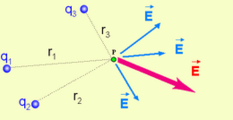 Even by adding more source charges, the individual electric fields created by each source charge are unaffected by subsequent charges.


Simple

Say that we have two positive particles at the above locations. Ignore the charges and distance provided for now. The electric field at the location of the negative charge is [math]\displaystyle{ \vec{E_1} = \lt 2\hat{i}+0\hat{j}+0\hat{k}\gt }[/math]N/C and [math]\displaystyle{ \vec{E_2} = \lt 0\hat{i}+2\hat{j}+0\hat{k}\gt }[/math]N/C. What is the net electric field at the location of the electron? Use the principle of superposition.
Answer:
Since we know the electric fields from both particles at the point, the superposition principle tells us that we must add the fields together to find the net field. Doing this gives us: [math]\displaystyle{ \vec{E_1} + \vec{E_2} = \lt 2\hat{i}+0\hat{j}+0\hat{k}\gt }[/math]N/C + [math]\displaystyle{ \lt 0\hat{i}+2\hat{j}+0\hat{k}\gt }[/math]N/C [math]\displaystyle{ = \lt 2\hat{i}+2\hat{j}+0\hat{k}\gt }[/math]
Therefore, the net electric field at the electron's location is [math]\displaystyle{ \lt 2\hat{i}+2\hat{j}+0\hat{k}\gt }[/math]N/C. Again it is important to note the effect of the signs. Since both components have positive notation, the net result is positive. However if any of the components had a negative direction, it would have been important to note this throughout the answer.
Difficult

If [math]\displaystyle{ Q_1 }[/math] and [math]\displaystyle{ Q_2 }[/math] are positive and negative charges with charges of 6 nC and -5 nC respectively, what is the net electric field at point A located at (0,0,0)? Charge [math]\displaystyle{ Q_1 }[/math] is located at (2,-2,0). Charge [math]\displaystyle{ Q_2 }[/math] is located at (5,0,0). To begin this problem, the first step is to find [math]\displaystyle{ r_1 }[/math] [math]\displaystyle{ r_2 }[/math], the vectors from the charges to point A as well as their magnitudes:
[math]\displaystyle{ \vec{r_1} = 0\hat{i}+0\hat{j}-(2\hat{i}+-2\hat{j})\Rightarrow\vec{r_1} = -2\hat{i}+2\hat{j} }[/math]
[math]\displaystyle{ ||\vec{r_1}|| = \sqrt{2^2 + 2^2} =\sqrt{8} }[/math]
[math]\displaystyle{ \vec{r_2} = 0\hat{i}+0\hat{j}-(5\hat{i}+0\hat{j})\Rightarrow\vec{r_2} = -2\hat{i}+0\hat{j} }[/math]
[math]\displaystyle{ ||\vec{r_2}|| = \sqrt{-5^2 + 0^2} =\sqrt{25} }[/math]
Again, sign notation is very important. Note how the unit vector defines the direction of the fields in this equation and example. It is easiest to define the unit vector first. Then proceed to multiply this my the magnitude of the field, as this allows you to account for direction before the calculation of field.
Using Coloumb's Law, you get:
[math]\displaystyle{ \vec{E_1} = \frac{1}{4 \pi \epsilon_0}\frac{Q_1}{||r_1||^2}\hat{r_1}=\frac{1}{4 \pi \epsilon_0}\frac{e}{8}\lt \frac{-2}{\sqrt{8}}\hat{i}+\frac{-2}{\sqrt{8}}\hat{j}\gt = \lt -4.77\hat{i}+4.77\hat{j}\gt }[/math]N/C
[math]\displaystyle{ \vec{E_2} = \frac{1}{4 \pi \epsilon_0}\frac{Q_2}{||r_2||^2}\hat{r_2}=\frac{1}{4 \pi \epsilon_0}\frac{e}{5}\lt \frac{-5}{\sqrt{25}}\hat{i}+\frac{0}{\sqrt{25}}\hat{j}\gt = \lt 1.8\hat{i}+0\hat{j}\gt }[/math]N/C
Next, you need to add the two electric fields together. Because of the superposition principle, the electric field caused by Q1, does not effect the electric field created by Q2, but both can be summed together to create the net electric field at point A.
[math]\displaystyle{ \vec{E}=\vec{E_1}+\vec{E_2} = \lt -2.97\hat{i}+0\hat{j}\gt }[/math]
Connectedness
How is this topic connected to something that you are interested in?
- The Superposition Principle is important because it makes your life easier in Physics. You can make assumptions based on the fact that the net field at any location is equal to the sum of all the individual fields. You don't know one of the individual fields, but know the net field? Simple subtraction can help you calculate each individual field. Imagine if all Electric Fields influenced each other? It'd be really difficult to calculate net electric fields without a complicated equation that takes into account one field as a function of another. yuck. Thank the Physics Gods for the Superposition Principle. Its very important to keep this idea in mind any time a net field comes up. Always remember that the independent fields are not individually effected by each other.

In a system such as this, the superposition principle is especially useful for finding the individual reactions at each point on the beam as it is known that the net reaction for the entire system is 0.
Is there an interesting industrial application?
- In this study, the Superposition Principle was used to analyze Solar Cells.
History
Daniel Bernouilli, in 1753, first proposed the idea of the Superposition Principle. He stated that "The general motion of a vibrating system is given by a superposition of its proper vibrations." His claim was rejected by mathematicians Leonhard Euler, and Joseph Lagrange. However they were eventually proved wrong by Joseph Fourier and it is now the concept you see today.
See also
Further reading
External links
Instructional video on how to calculate the net electric field using the superposition principle
Video detailing the general use of the principle
References
Chabay, Ruth W.; Sherwood, Bruce A. (2014-12-23). Matter and Interactions, 4th Edition: 1-2 (Page 522). Wiley. Kindle Edition.
https://www.slideshare.net/tarungehlot1/determinate-structures